Palmetto and Underbrush Clearing in Palm Coast, FL
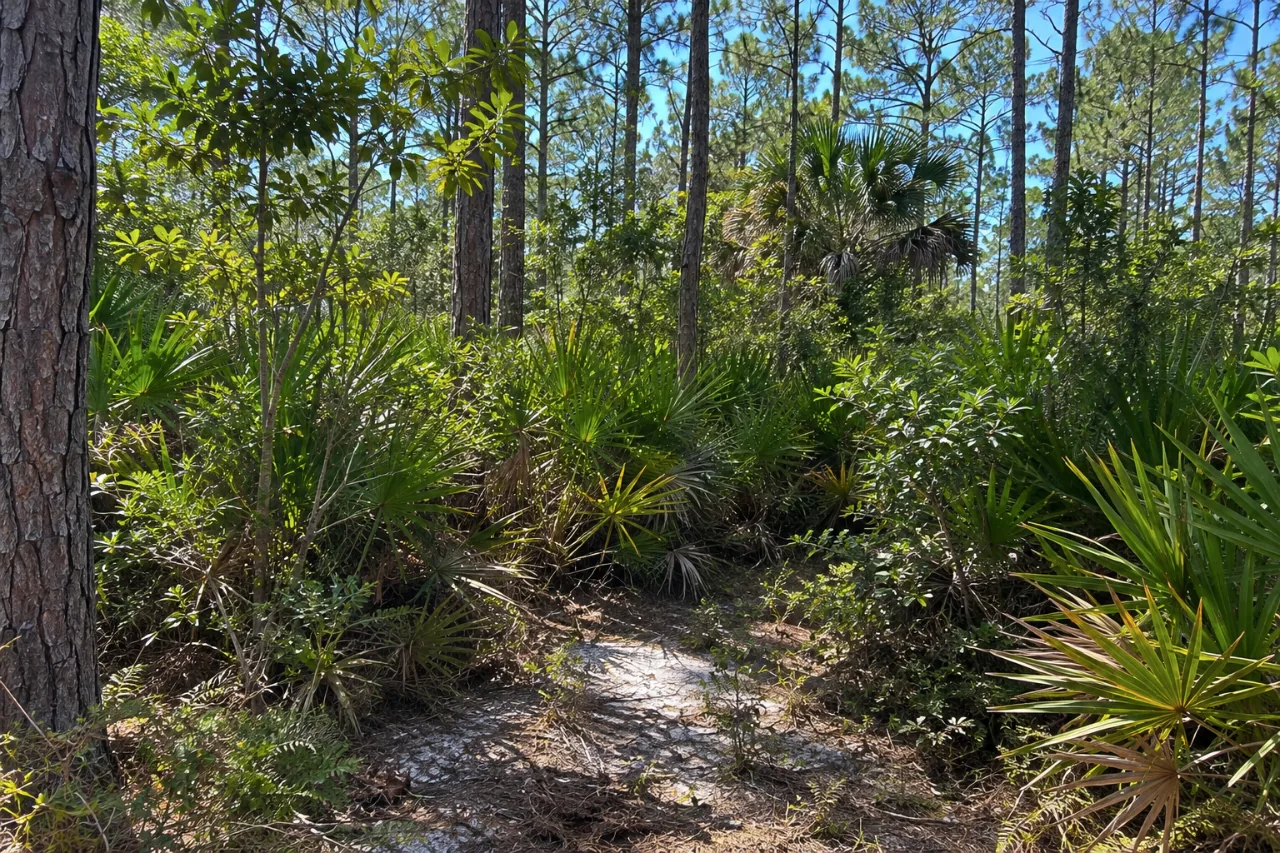
Palmetto and underbrush clearing in Palm Coast usually starts with one of three situations: an empty lot that has grown up against a house, the back edge of your own yard, or acreage where brush has closed in under the pines. Each comes with different limits. This page covers the city's wildfire-hazard rule for brush near homes, where brush work turns into tree removal, the methods, protecting the trees you keep, and holding regrowth down.
The three-foot, 30-foot rule
Palm Coast's code enforcement summary of its most common violations explains the city's wildfire-hazard rule (Palm Coast Code, Chapter 25, Article IV): brush on an undeveloped lot that averages more than three feet tall counts as a fire hazard when it's within 30 feet of an existing residence. The same summary lists excessive or untended growth of weeds and undergrowth as a public nuisance. The city notes the summary is informational, not the adopted code text.
Code Enforcement handles wildfire mitigation complaints at (386) 986-3764. The Urban Forestry Division takes inspection requests for wildfire hazards, hazard trees and tree removal at (386) 986-3758. If the overgrown lot isn't yours, that inspection request is the route; clearing someone else's land needs the owner's permission.
Where brush work turns into tree removal
The city's tree rules hang on trunk size. A trunk of 6 inches or more at four and a half feet is protected, and so is a smaller one that was counted toward the lot's tree minimum. Separately, the code bars clearing trees, filling and excavating a vacant lot before a building permit is issued. So on an empty lot, the safe line for brush work is clear: cut the palmetto and undergrowth above the ground, take nothing with a protected trunk, and don't rake out roots or regrade.
If you own the lot next to your house, the code allows more: that lot can be cleared of pines, brush and trees under 6 inches, as long as it keeps its tree minimum, through the city's Lot Clearing permit. Anywhere the line isn't obvious, ask the Building Division at (386) 986-3780 before the work starts. See Palm Coast tree permits for sizes and counts.
Ways to take brush back
- A hand crew with brush cutters and saws. Slowest, but it fits along fences, around keeper trees, beside pools and patios, and on the city right-of-way behind a lot, where the Right of Way Beautification permit allows hand work only.
- A forestry mulcher. Shreds palmetto and brush into chips in one pass and leaves nothing to haul. It needs room to maneuver and clear marking of every tree that stays. See forestry mulching.
- A heavy rotary mower or brush cutter on a tractor or skid steer. Suited to keeping ground that's already been opened up, rather than first cuts through tall, dense palmetto.
Many jobs mix them: machine work in the open middle, hand work at the edges.
Protecting the oaks and pines
Clearing under a tree often comes with a request to "clean it up" by cutting off its lower limbs. Be careful with that in Palm Coast. The city's pruning rules require ANSI A-300 practice, and raising the lower branches above a third of a tree's total height counts as effective removal, the same as cutting it down, as do topping, lion-tailing and hat-racking. Tell the crew how high they may prune, and keep heavy machines off the root zone of the trees you're keeping.
Before any machine work, walk the area for gopher tortoise burrows. The FWC treats any work within 25 feet of a burrow as a disturbance that needs a permit unless all burrows are avoided by that distance. See tortoises on a lot.
Invasive plants
The city's tree code exempts invasive species on the Florida Department of Agriculture and Consumer Services noxious weed list: removing them needs no tree permit and no replacement. If a vine or shrub on the lot looks like one, ask Urban Forestry to confirm what it is before treating it as exempt.
What happens to the cut brush
- Mulched in place, which leaves nothing to move.
- Hauled. City curbside yard waste is limited to what one person can handle, under 4 cubic yards, so larger loads leave by trailer.
- Burned, rarely. State rules for yard waste allow a pile no wider than 8 feet, at least 150 feet from occupied buildings other than your own, 50 feet from a paved public road and 25 feet from brush or woods, and nothing can be burned during a county burn ban. Between occupied houses, the 150-foot distance usually rules it out. See burning clearing debris.
Keeping regrowth down
Cutting brush above ground leaves its roots alive, so it grows back. Plan on follow-up mowing or trimming, and keep an eye on the city's three-foot average along any strip within 30 feet of a home. Regular light trimming keeps each visit small and the strip within the rule.
What brush clearing costs
HomeAdvisor's national mulching guide lists $125 to $200 an hour for underbrush and small trees and $200 to $400 an hour for heavy, dense brush. Angi's 2026 land clearing guide puts general contractor time at $110 to $250 an hour. These are national figures, checked October 2026, not local prices; a contractor's written quote after seeing the brush is what counts. More on cost.
Underbrush questions
Is it legal to clear brush on the empty lot next door?
Only with the owner's permission, and within the city's rules. If the brush is a fire hazard near your home, an Urban Forestry inspection request at (386) 986-3758 puts it in front of the city.
Will a contractor pull the palmetto roots too?
Pulling roots is grubbing, which disturbs the soil. On a vacant Palm Coast lot without a building permit, treat it as off limits until the Building Division says otherwise.
How often does a brush strip need cutting?
Often enough that it stays well under three feet on average. Growth varies by site and season, so ask the contractor what schedule fits your strip.
Have a lot or acreage in Flagler County to clear?
Call or send a short request, and one independent contractor can come look at it. The referral is free.