
Gopher Tortoise Burrows on a Palm Coast Lot
A gopher tortoise burrow on a Palm Coast or Flagler County lot doesn't end the plan for a house, but it adds a state step before any clearing. The gopher tortoise is a state-listed threatened species, and the Florida Fish and Wildlife Conservation Commission (FWC) decides when work near a burrow needs a permit. This page covers the 25-foot rule, the permit most single lots use, how tortoises are moved, and who to call.
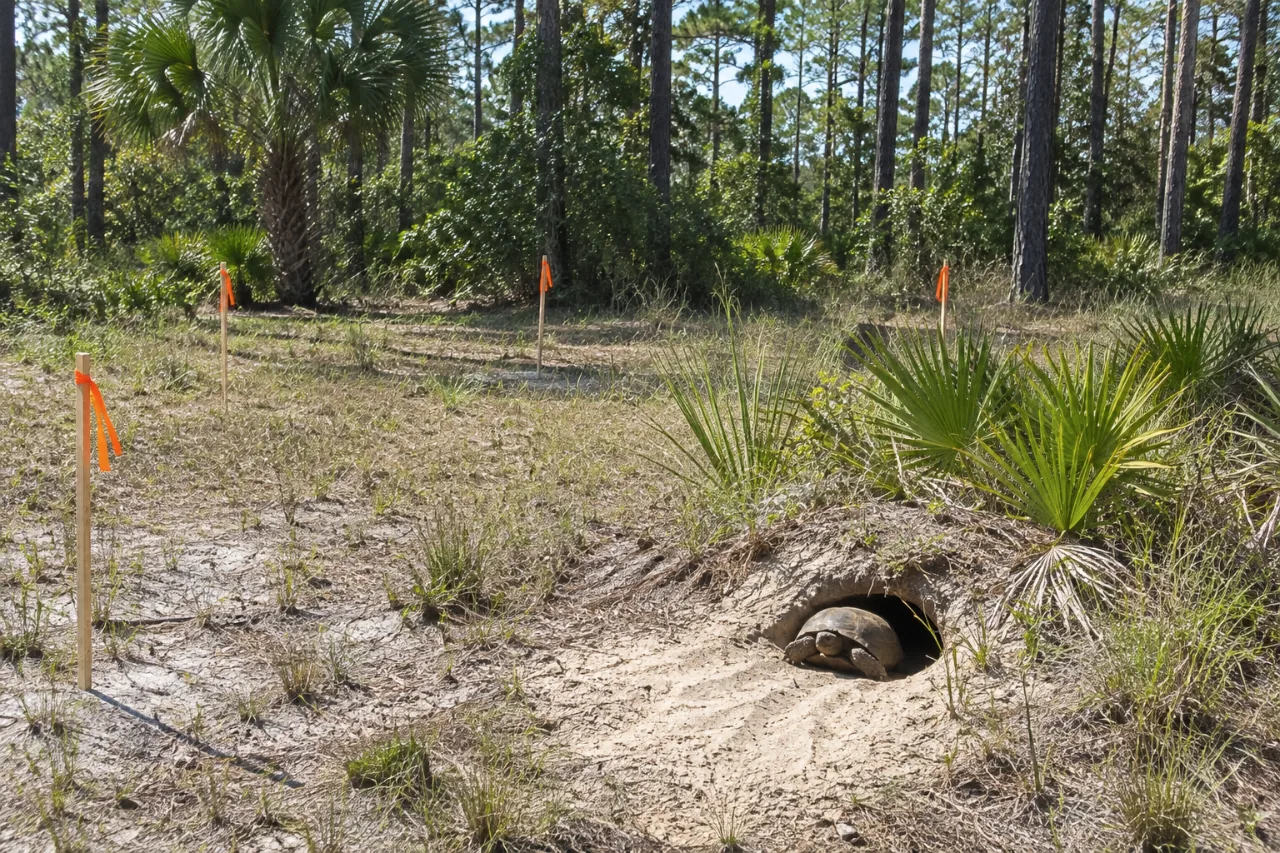
The 25-foot rule
The FWC's permit page says a disturbance "includes any type of work within 25 feet of a gopher tortoise burrow," and a permit is needed when a potentially occupied burrow will be disturbed or damaged. Its FAQ puts the other side of it just as clearly: no FWC permit is required if every burrow is avoided by 25 feet in all directions.
Ordinary lawn and landscape upkeep is generally exempt, provided burrows aren't collapsed and tortoises aren't hurt. Clearing with machines is a different matter. The property line doesn't limit the rule, either: the FAQ warns that work within 25 feet of a burrow on the adjoining property can still make you responsible if it collapses that burrow or harms the tortoise inside.
Why a house lot rarely clears the buffer
A 25-foot circle around a single burrow covers close to 2,000 square feet. On a narrow lot between two houses, one burrow near the middle can sit under the footprint, the driveway or the only route in for a machine. So the first question on any wooded lot is whether there are burrows, and where, before the clearing price is settled. Count the neighbors' side of each line too.
Where a burrow is near an edge of the lot, the answer can be as simple as staking a 25-foot ring, keeping every machine and debris pile outside it, and planning the house around it. Write that ring into the contractor's quote.
The 10 or Fewer Burrows permit
Most single lots use this one. The FWC's 10 or Fewer Burrows page says it fits when the development site has 10 or fewer burrows, they can't all be avoided by 25 feet, and either suitable habitat will remain on the site or the tortoises will be moved off it.
- Who may handle the tortoises: someone who has completed the FWC's online e-Learning course, or an Authorized Gopher Tortoise Agent. Landowners can survey their own property.
- A limit to know: the FWC limits registered agents to two 10 or Fewer Burrows permits in a lifetime. Ask the FWC about the Authorized Gopher Tortoise Agent permit for anything beyond that.
- What the application needs: the burrow survey results, a site plan showing all planned construction, and an aerial photo marking the project boundaries, the recipient area, any pen, and the silt fencing that keeps tortoises out of the work zone.
Moving the tortoises: on the lot or off it
On-site. The property owner instructions require a recipient area of at least 750 square feet of suitable habitat, at least 10 feet wide, with half of it at least 25 feet from the construction boundary. Tortoises can be captured by bucket trapping, hand-shovel excavation or live trapping, and may be penned during trapping, with no more than five to a pen of at least 100 square feet. They're released once trapping is done or 10 days have passed, whichever comes first, with temporary fencing keeping them out of the construction area. On a small lot, finding 750 square feet that will stay natural is often the sticking point.
Off-site. An Authorized Gopher Tortoise Agent captures the tortoises and takes them to a permitted recipient site. The agent charges for the work, and the recipient site charges to accept tortoises. The FWC notes that its mitigation contribution is the same whichever route you choose, and that on-site relocation is the more economical one.
Bigger sites and other permits
On acreage or a site with more than 10 burrows, the FWC has other permit types, including Mitigation, Conservation, Temporary Exclusion and Disturbed Site permits. An Authorized Gopher Tortoise Agent or the regional FWC biologist can say which one a site needs. The FWC's enforcement policy covers some routine farm and forestry activities, and its FAQ lists examples such as tilling, planting, mowing, harvesting and prescribed burning. Ask the FWC before assuming a particular clearing job falls under it. See acreage clearing for larger tracts.
Cost and timing
FWC staff don't relocate tortoises; permitted agents do. Get a written price from the agent that spells out the survey, the permit filing, trapping, fencing, and any recipient-site fee, plus how long trapping is expected to take. Build that time into the clearing schedule, since machines stay out of the 25-foot ring until the tortoises are gone and the permit conditions are met.
Who to contact
- FWC, main office in Tallahassee: (850) 488-4676. The permit pages ask applicants to work with their regional gopher tortoise biologist.
- Finding an agent: the FWC's online permit map shows Authorized Gopher Tortoise Agents and recipient sites.
- Reporting harm to tortoises: FWC Wildlife Alert Hotline, (888) 404-3922.
Tortoise questions
Will a contractor clear around a burrow without a permit?
Only if every machine, cut and pile stays at least 25 feet from every burrow in all directions. Stake the ring before work starts and point it out on the walk-through.
Is it legal for an owner to move a tortoise to the back of the lot?
Not without a permit. Under the 10 or Fewer Burrows permit, the person handling tortoises must have completed the FWC's e-Learning course or hold an Authorized Agent permit.
What if a tortoise turns up after clearing has started?
Keep machines away from it and its burrow, and call the FWC at (850) 488-4676 for the regional biologist before going further.
Have a lot or acreage in Flagler County to clear?
Call or send a short request, and one independent contractor can come look at it. The referral is free.