Palm Coast Tree Removal Permits and Tree Rules
Palm Coast tree removal permits apply to more trees than most owners expect. Whether you're clearing a lot for a new house or taking one oak out of a finished yard, the city's rules decide what can come down, what has to be measured first and what has to be planted back. Below are the sizes, surveys and tree counts from Chapter 11 of the city's Unified Land Development Code, how the rest of Flagler County compares, and who to call.
Which trees the city protects
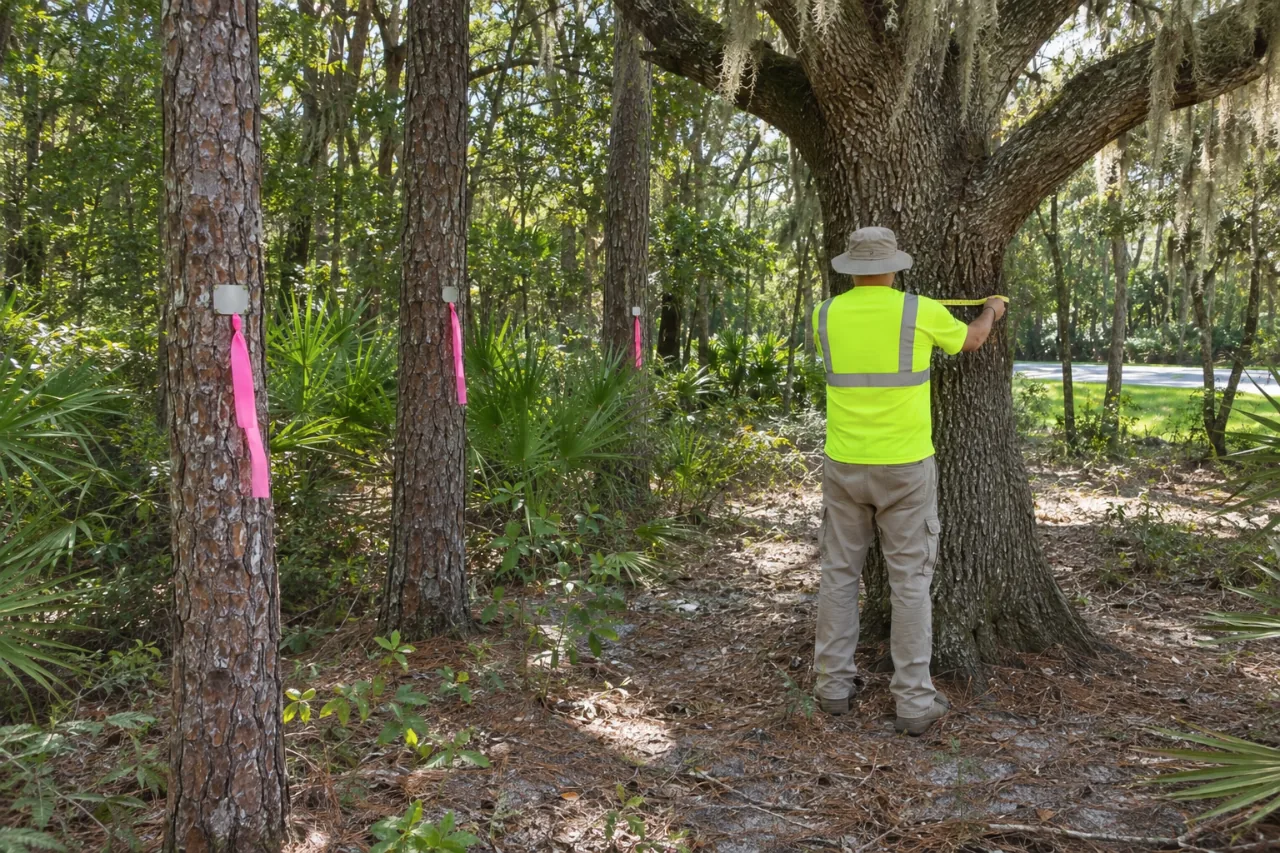
Trunks are measured at breast height; the city's help center puts that at four and a half feet above grade. Section 11.02.01 of the code sorts trees into three tiers, and invasive species are left out of all of them.
- Protected
- A trunk 6 inches or more across, or 4 inches or more if the tree was surveyed for credit. On single-family and duplex lots, trees of 1.5 to 6 inches planted to meet the tree minimum, or credited earlier, are protected too.
- Specimen
- A protected tree 24 inches or more, except sand pines. Some species qualify smaller: 18 inches for oak, elm, hickory, green ash, sycamore, maple and date palm; 12 inches for cypress, magnolia, loblolly bay, red bay, scrub oak and red cedar.
- Historic
- A protected tree with a trunk 36 inches or larger.
These figures come from the city's posted copy of Chapter 11, Ordinance 2016-6, and its single-family landscape summary. The code in force is on Municode; ask the Building Division at (386) 986-3780 if anything has changed. Checked October 2026.
When a permit is needed
The city's help center answers it directly: a permit is needed to cut down, remove, damage or destroy by pruning any tree with a trunk 6 inches or more across at four and a half feet, or 4 inches or more if it was surveyed for credit.
- New house on a vacant lot. The single-family building permit acts as the tree removal permit, and nothing may be cleared before it's issued. See lot clearing.
- Removal tied to another approved permit, such as a grade-and-fill or site development permit. No separate tree permit is needed; the removal is reviewed with that permit.
- Anything else. An application goes to the city before any protected tree comes down.
- No permit needed for invasive species on the state's noxious weed list, or for trees on single-family lots that a utility company has already cut back severely.
Taking a tree out of a yard with a house on it
On a developed single-family lot, protected trees beyond the lot's tree minimum can come out with a permit and no replacement. Trees the lot needs to stay at its minimum must be replaced. Removing a specimen tree means planting one shade tree; removing a historic tree means planting two, at least one of them a shade tree.
Under section 11.02.05.E, after an application and an on-site check by a certified arborist or the Land Use Administrator, the city can allow removal of trees that are dead, severely diseased or injured; that pose imminent danger; that block sight lines along a public road; that damage a foundation, driveway, patio, wall or water or sewer line; and pine trees within 30 feet of a structure, or closer than the tree is tall, with the owner's agreement.
Pruning doesn't need a permit, but the city's pruning notice requires ANSI A-300 practice and treats topping, lion-tailing, hat-racking, and raising the lower limbs above a third of the tree's height as "effective removal," which is handled like cutting it down. Urban Forestry takes inspection requests for tree removal, hazard trees and wildfire concerns at (386) 986-3758.
What goes on a tree survey
- It must be done within the last 24 months, with each trunk measured at breast height.
- For a new home, the permit checklist wants every protected tree named by species.
- On single-family lots, protected trees of 6 inches or more in the front, rear and street-side setbacks are surveyed if they'll be used for credit.
- Specimen and historic trees are surveyed across the whole lot.
- In some cases the code accepts a count of protected trees, by species and diameter, instead of a full located survey.
How many trees a lot has to keep
Every single-family lot needs at least one tree per 2,500 square feet of lot area, or major fraction of it, not counting ponds, lakes and canals. A 10,000-square-foot lot, for example, needs four. On lots of an acre or more, the count applies only to the part being developed. The lot also needs at least one shade tree, preferably in front, rising to two from a third of an acre, three from two-thirds of an acre, and four at an acre or more.
New shade trees go in at 2-inch caliper and understory trees at 1-inch caliper in at least a 15-gallon container. A cluster of three palms with 3 feet of clear trunk can stand in for a shade tree, covering up to half of the shade trees required, though at least one real shade tree is still needed. At least 60 percent of the lot's pervious open space must be planted or kept as native vegetation. Every tree you save on the survey is one less to buy and plant later.
Outside the city: Flagler County, Bunnell and Flagler Beach
Unincorporated Flagler County has its own numbers. Its single-family permit packet, with a tree protection form effective September 18, 2024, protects trees of 6 inches and up, calls 18-inch trees specimen and 36-inch trees historic, and asks for a tree survey under 24 months old prepared by a Florida licensed land surveyor. A new home must preserve or replant at least half of the lot's pre-development trunk inches, with replacement trees of at least 2½-inch caliper, and the landscape form asks for one tree per 2,500 square feet. An owner whose lot has no protected trees signs a certification saying so.
The county's posted fee schedule lists $50 for a tree removal application review and $10 per non-exempt tree for a tree protection compliance review; confirm current fees with Growth Management at (386) 313-4000. The City of Bunnell's Community Development office is at (386) 437-7516, and the City of Flagler Beach's Planning and Building Department is at (386) 517-2000, extension 230. Ask either one about its own tree rules before cutting.
Tree permit questions
Does a pine count as a protected tree?
Yes, once its trunk reaches 6 inches. Sand pines are the one kind excluded from specimen status. A pine within 30 feet of a house, or closer than its own height, is one of the cases the city can approve for removal after an application and inspection.
Is a permit still needed for a dead tree?
Apply first. Dead and severely diseased trees are on the list the city can approve after an on-site check. On a developed lot, the city's single-family summary requires a replacement for any tree the lot needs to stay at its tree minimum; ask the Building Division at (386) 986-3780 how that applies to a dead tree.
What does a Palm Coast tree permit cost?
The city's permit portal has a fee calculator, and the Building Division at (386) 986-3780 can quote the current fee for your permit type.
Have a lot or acreage in Flagler County to clear?
Call or send a short request, and one independent contractor can come look at it. The referral is free.