
Lot Clearing in Palm Coast, FL
Lot clearing in Palm Coast almost always means a platted single-family lot being readied for a house, and the city fixes the order of events: no trees cut, no fill brought in and no digging until the building permit is issued. This guide walks through that sequence, what the surveys and grading plan decide, how to protect the trees that stay, the swale and driveway, tortoises, debris, and what published prices look like.
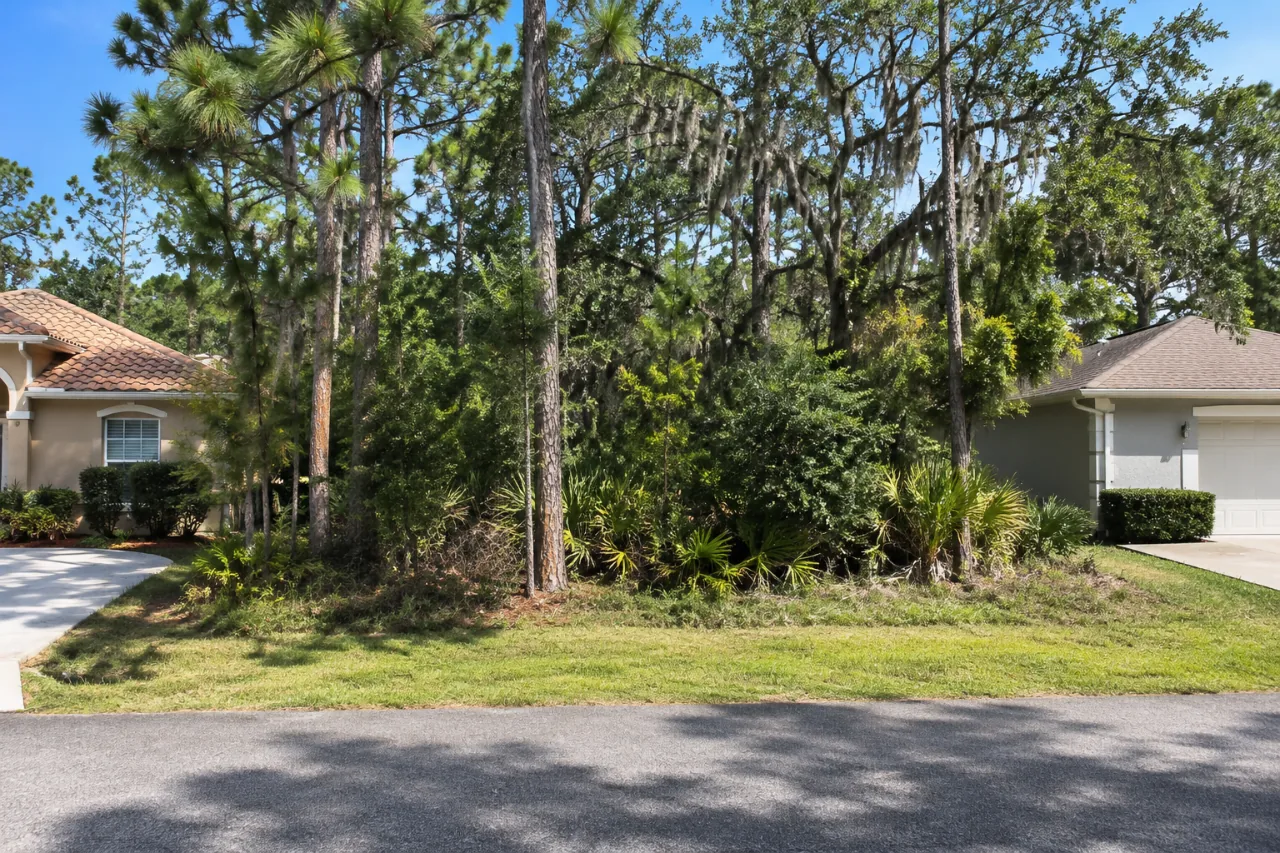
The sequence for a Palm Coast lot
- Survey the lot. The city's single-family permit package asks for a sealed topographic survey on the 1988 NAVD datum with a lot grading plan, plus a tree survey no more than 24 months old that names each protected tree by species and trunk diameter.
- Design around the trees worth keeping. The site plan and landscape plan show what stays, and how the finished lot will still have at least one tree for every 2,500 square feet.
- Get the utility sign-off. The checklist calls for a water and sewer receipt from the utility, with the approved site plan attached.
- Wait for the building permit. Once issued, it acts as the tree removal permit for the trees the approved plan shows coming out.
- Walk the lot for tortoise burrows before any machine moves. Work within 25 feet of one needs an FWC permit.
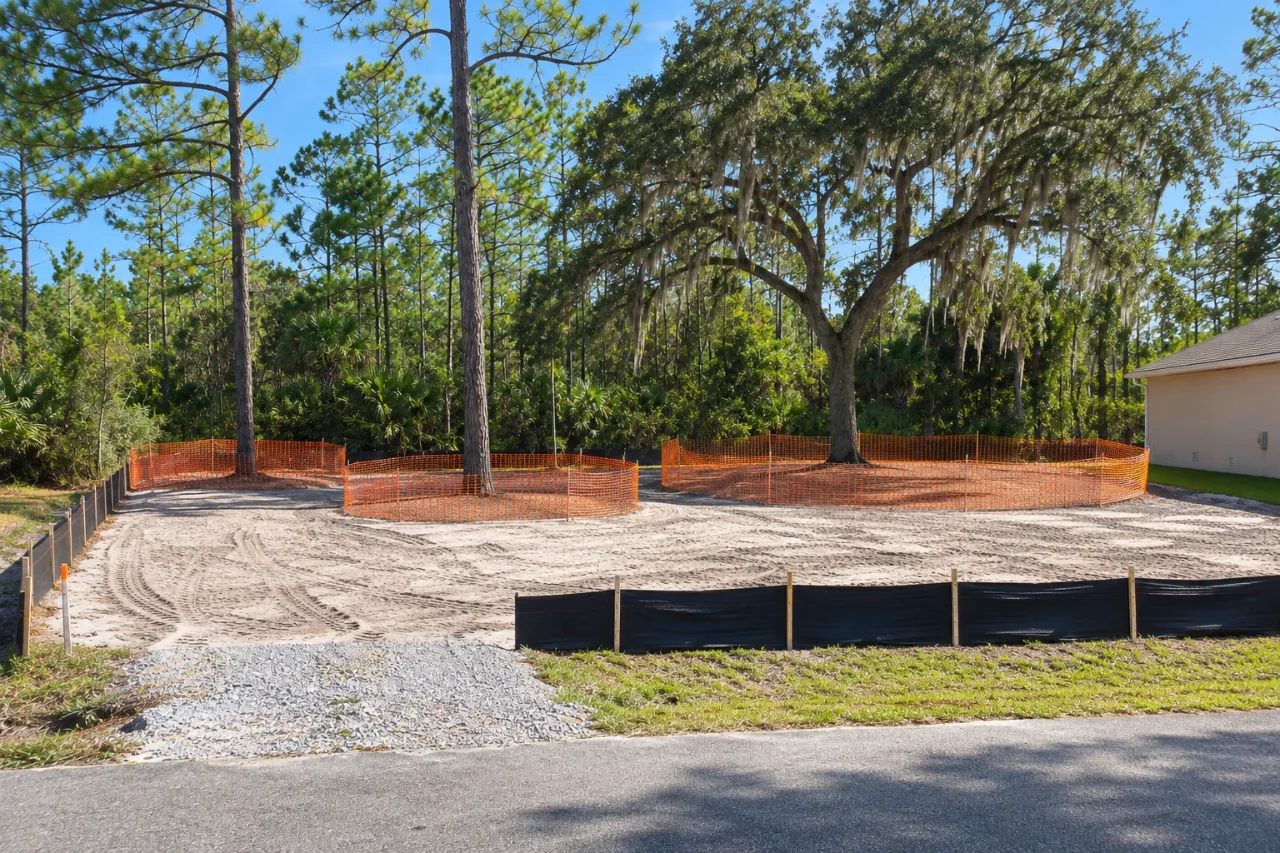
- Fence the keepers, then clear only the approved area.
- Grade, restore the swale, and survey again. A final topographic survey shows the city the swale meets grade and the lot matches its grading plan.
Why the building permit has to come first
Chapter 11 of Palm Coast's Unified Land Development Code makes it unlawful to clear trees, fill land, excavate or dredge a parcel before a single-family building permit or a site development permit is issued, unless the code says otherwise or the Land Use Administrator authorizes it. It then says plainly that "the building permit shall act as the tree removal permit." That's from the city's posted copy of the chapter as rewritten by Ordinance 2016-6; the current text lives in the city's code on Municode, and the Building Division at (386) 986-3780 can confirm the wording in force before you schedule anything.
Getting ahead of the permit is costly. Under the same chapter, each tree damaged or removed without approval is a separate violation, on a single-family lot each one has to be replaced under the code's replacement table, a site cleared without an approved tree survey may have to pay into the city's tree replacement fund, the Land Use Administrator can issue a cease-and-desist order, and further fines can come from the Code Enforcement Board.
The three exceptions, including the lot next door
The code lists only a few ways to clear a vacant lot before a house is permitted:
- Partial clearing so a seawall can be built.
- Partial clearing to dig out unsuitable debris or muck within the buildable area. The city wants written proof of the unsuitable fill from a testing agency.
- A vacant single-family lot owned together with the developed lot beside it can be cleared of all pines, brush and trees under 6 inches, as long as the minimum tree count is kept or replanted. This is the route for owners who bought the empty lot next to their house.
These go through the city's Lot Clearing permit. The permit checklist asks for a right-of-way application, a topographic survey, a grading plan that marks the trees coming out, hardwoods over 6 inches noted on the survey, and a notice of commencement for jobs of $2,500 or more. Trees that stay must be barricaded, the lot must still hold one tree per 2,500 square feet, and Zoning, Stormwater and Urban Forestry all review the application.
Keeping the right trees
On a new single-family home, the code lets a specimen or historic tree inside the buildable area be removed without mitigation, but only if reasonable efforts to shift or flip the house footprint can't save it. Every lot also needs at least one shade tree, more as the lot gets bigger: two from a third of an acre to under two-thirds, three up to an acre, and four above that. Existing trees you keep can count toward the one-per-2,500-square-feet minimum if they're at least the size a new planting would have to be.
The chapter requires protective barriers around keepers during construction, built and pruned to ANSI A-300 standards. In practice that means tagging each one before the machine arrives, fencing it well out from the trunk, keeping fill and parked equipment off its roots, and writing those limits into the contractor's quote. The tree permit guide covers sizes and surveys in more depth.
The swale, the driveway and the right-of-way
The grassy swale along a Palm Coast street sits in the city's right-of-way, and the city checks its grade at the end of the job. A new home's permit needs a driveway detail matching the city's residential culvert drawing (DWG no. 002-270605), with the driveway width shown at the property line and at the edge of pavement, and the landscape rules require swales in the right-of-way to be sodded. Questions about culverts, driveways and drainage go to Construction Management and Engineering at (386) 986-3794.
For clearing on a city right-of-way behind a lot, such as a strip toward the water, the city has a separate Right of Way Beautification permit. Its rules are strict: all work by hand with no heavy equipment, a 10-foot setback from the side property lines, and everything outside the permitted area left natural.
Gopher tortoises
The FWC defines a disturbance as any work within 25 feet of a gopher tortoise burrow. If every burrow can be avoided by that distance, no permit is needed; on a narrow lot, that's often impossible, and the tortoises have to be moved under an FWC permit before clearing. A burrow on the neighbor's side of the line still counts if your work would collapse it. Gopher tortoises on a lot explains the permits.
Where the debris goes
- Hauled off. City curbside yard waste is limited to what one person can handle, under 4 cubic yards, so a lot's worth of trees and stumps leaves by truck.
- Mulched in place along the back and sides of the lot, outside the building area. See forestry mulching.
- Burned only with a Florida Forest Service authorization and never during a county burn ban, which is rarely workable between occupied houses. See burning clearing debris.
- Not buried. Wood left under a slab or driveway rots, and the ground above it settles.
What lot clearing costs
Angi's 2026 national cost guide, checked October 2026, puts clearing a half acre at $250 to $1,000 when lightly wooded and $1,800 to $2,800 when dense, with contractor time at $110 to $250 an hour. It lists stump grinding at $120 to $400 a stump, debris hauling at $130 to $370, and grading and leveling at $1,000 to $3,300, and gives a Florida average of $3,890 per clearing job.
Those are published national and statewide figures, not Palm Coast prices. Keeper trees, the haul-off, swale restoration and any tortoise work can matter as much as the size of the lot. The figure that counts is the one a contractor writes down after walking the lot. More on cost.
Lot clearing questions
Can a contractor start while the permit is still in review?
Not inside the city. The code ties clearing to an issued permit, not an application. Book the clearing for after the permit is in hand.
Should the whole lot be cleared at once?
Only the area the approved plan shows. Clearing past it can put the lot under its tree minimum, which then has to be made up with new plantings.
Who handles the paperwork?
The building permit is pulled by the builder or by an owner-builder. Put in writing who arranges the tortoise survey, any right-of-way application, and the final survey.
Getting a quote for a lot
Call or use the form with the lot's neighborhood, whether the building permit has been issued, and whether you have the tree survey yet. The request goes to one independent contractor who clears house lots in Flagler County, who will look at the lot and give you a written price. Whether to hire them is up to you, and the referral is free.
Have a lot or acreage in Flagler County to clear?
Call or send a short request, and one independent contractor can come look at it. The referral is free.