
Acreage Clearing in Bunnell and Western Flagler County
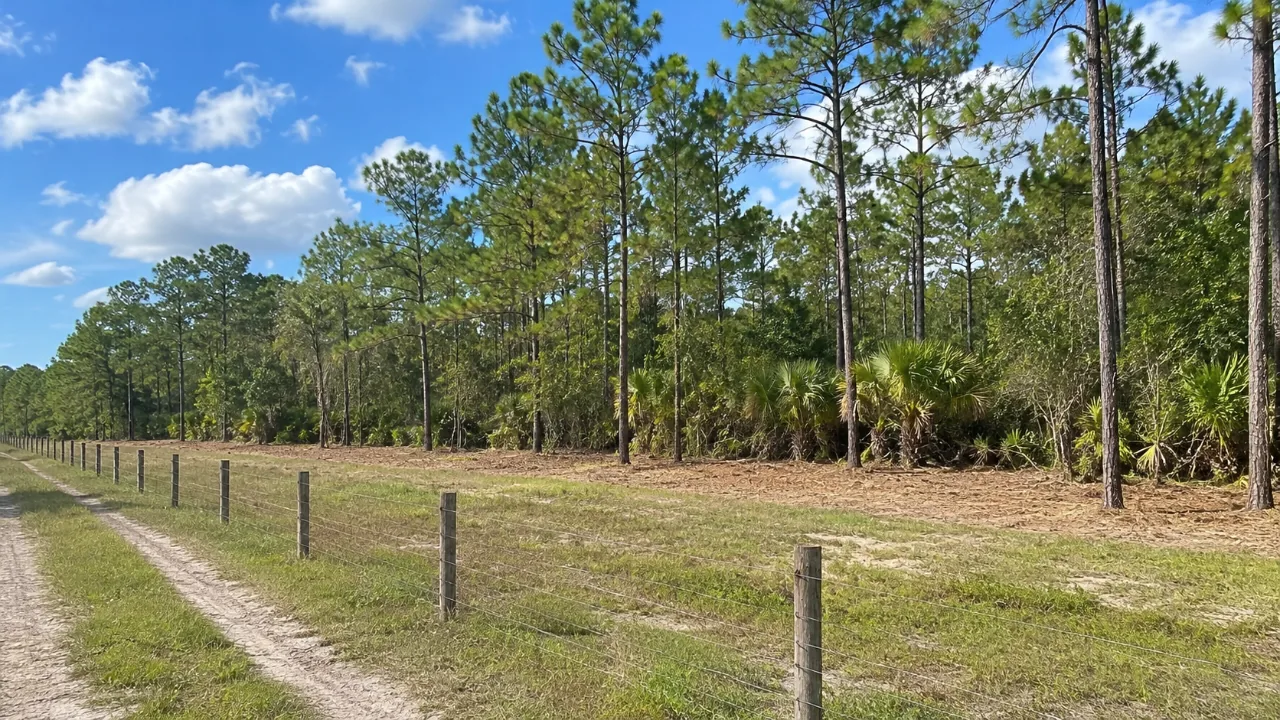
Acreage clearing in Flagler County mostly happens west of Palm Coast, around Bunnell, Espanola, Korona and the farm and pine land beyond them, where parcels are counted in acres instead of lots. The rules and the work differ from a Palm Coast house lot: county or Bunnell permits rather than the city's, the water management district on low ground, flood zones, and much more debris. Here's how to plan a larger clearing job.
First, whose rules apply
- Unincorporated Flagler County: Growth Management, 1769 East Moody Blvd, Bunnell, (386) 313-4000.
- Inside the City of Bunnell: the city's Community Development and Building Division, 2400 Commerce Parkway, (386) 437-7516.
- Inside Palm Coast, even on a large parcel: the city's rules on the tree permits page.
Either county or city staff can tell you from the parcel number which one covers your land. The state rules for tortoises, wetlands and burning apply everywhere.
Clearing for a house in the county
When the clearing leads to a new home in unincorporated Flagler County, the building permit packet brings the county's tree rules with it. The single-family packet's tree protection form, effective September 18, 2024, protects trees with trunks of 6 inches or more, sets specimen trees at 18 inches and historic trees at 36, and asks that development be designed to save as many specimen and historic trees as practicable. A new home must preserve or replant at least half of the pre-development trunk inches, with replacement trees of at least 2½-inch caliper. The tree survey must be less than 24 months old and prepared by a Florida licensed land surveyor.
On a big parcel, that 50 percent counts every protected trunk on the survey, which is a strong reason to clear only the homesite, the drive and the septic area rather than the whole tract. Mapping the large trees before any machine work keeps that option open.
The driveway, septic and drainage paperwork
- Driveway onto a county road: a right-of-way permit with a site plan signed and sealed by a Florida registered professional. The county's application calls for a 40-foot concrete or HDPE culvert, concrete at least 6 inches thick in the right-of-way, no pavers in a county-maintained right-of-way, and all disturbed ground restored before the final engineering inspection. The posted fee schedule lists a residential driveway at $30 for the permit plus $50 for inspection.
- Well and septic: the county's building checklist calls for well and septic tank permits from the Environmental Health department, and the site plan has to show the proposed septic system's location and top elevation. Keep machines off the likely drainfield area until it's settled.
- Drainage: the county's drainage affidavit prohibits erosion of fill or disturbed soil onto neighboring land or environmentally sensitive areas, so plan silt fence or a vegetated buffer along low edges.
A site development plan carries its own fees on the county's schedule; ask Growth Management whether your project needs one.
Wet ground and the water management district
Palm Coast's permit checklist points owners to the St. Johns River Water Management District, noting that the district encourages a call before any clearing, and the district's permitting staff handle Environmental Resource Permit questions. If a tract has low ground, standing water after rain, or ditches that carry water off the property, ask the district whether that area needs a permit before the machine arrives.
The district's headquarters is at 4049 Reid Street in Palatka, (386) 329-4500 or (800) 451-7106, and its permitting customer service line is (386) 329-4570. Its permitting page says applicants can arrange a pre-application conference with a district engineer or environmental specialist, which is the simplest way to learn whether a given area needs a permit.
Flood zones
The county's permit checklist asks for a FEMA Elevation Certificate if a parcel is within a FEMA Special Flood Hazard Area, and the site plan has to show the flood zone. Ask Growth Management at (386) 313-4000 whether your parcel is mapped in one before planning fill or pad height, since that affects how much ground gets disturbed.
Stumps, debris and burning on a tract
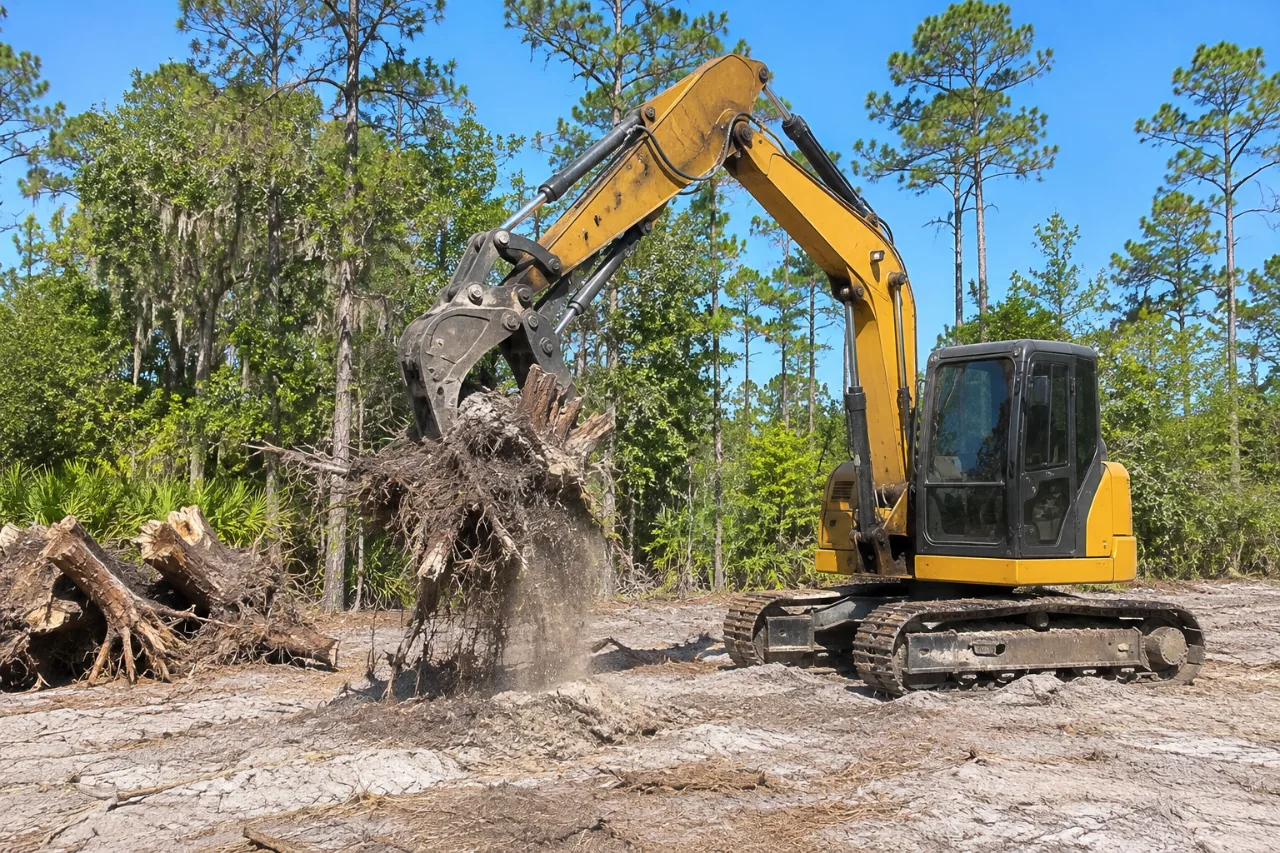
Acreage produces more wood than any trailer wants to haul. The usual choices are mulching it where it stands, grinding piles on site, hauling the larger logs, or burning. Burning land-clearing piles requires authorization from the Florida Forest Service before the fire is lit, under section 590.125 of the Florida Statutes, and state air rules require the fire to stay on the site where the debris came from, be lit after 9 a.m. Eastern, have no visible flame from an hour before sunset, and be attended with extinguishing equipment at hand. No burning happens during a Flagler County burn ban. The burning guide covers the rest.
Stumps come out wherever a house, a driveway, a pond bank or a mowed field will go; elsewhere they can be ground or cut low. See stump grinding.
Tortoises on a larger tract
The FWC's 25-foot rule applies on acreage too, but there's more room to work around burrows. A site with more than 10 burrows that can't be avoided falls outside the 10 or Fewer Burrows permit and into the FWC's other permit types. The FWC's enforcement policy covers some routine farm and forestry work, with examples such as tilling, planting, mowing, harvesting and prescribed burning; ask the FWC at (850) 488-4676 before assuming a particular job is covered. See gopher tortoises.
What acreage clearing costs
Angi's 2026 land clearing guide puts a lightly forested acre at $500 to $2,000 and a densely forested acre at $3,600 to $5,600, with grading and leveling at $1,000 to $3,300. For mulching instead of full clearing, Angi's mulching guide gives $400 to $1,500 an acre and HomeAdvisor's guide $400 to $1,500 an acre. These are national figures, checked October 2026, not local prices. On a tract, the debris plan, wet ground and how many stumps must come out often move the total more than the acreage does, and the contractor's written quote is what counts. More on cost.
Acreage questions
Should a future homesite be mulched or grubbed?
Often both: grub the house pad, driveway and septic area down to clean sand, and mulch the rest. That keeps the disturbed area small and more of the tract's trees counted toward the county's 50 percent.
Is a permit needed to clear land for pasture?
Ask Growth Management at (386) 313-4000, or Bunnell at (386) 437-7516 inside the city, and call the water management district at (386) 329-4570 about any wet ground.
Will a contractor work a tract in phases?
Ask on the walk-through. If the answer is yes, have each phase priced and described separately in the written quote, including when the machine comes back.
Have a lot or acreage in Flagler County to clear?
Call or send a short request, and one independent contractor can come look at it. The referral is free.